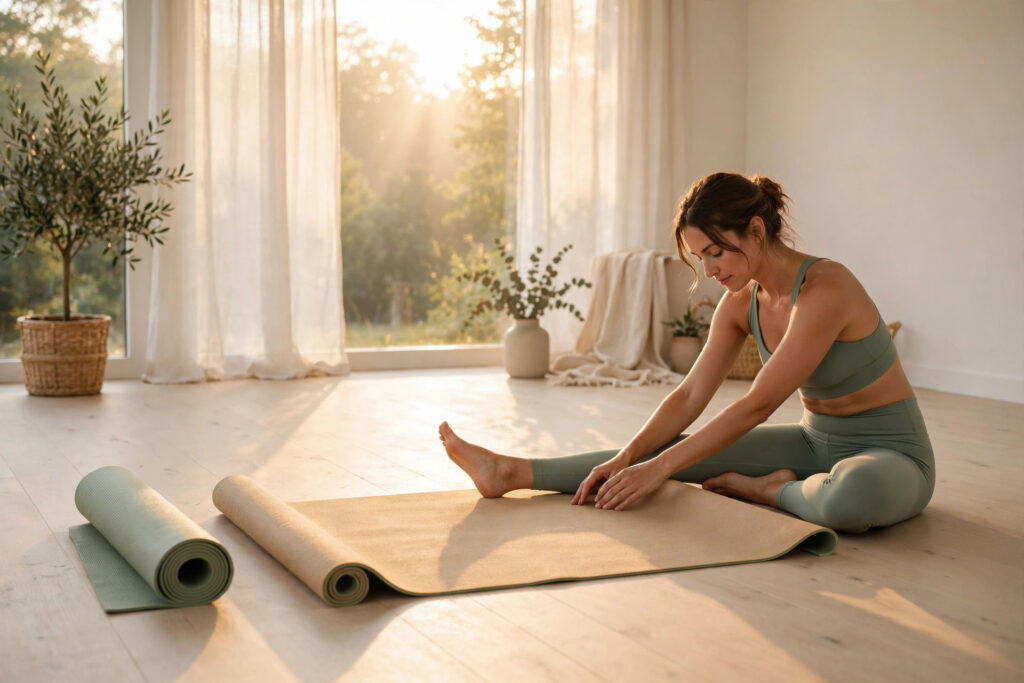
The short answer: most people should buy a standard-size mat (about 68 × 24 inches) between 4 and 6 mm thick, with the material matched to their practice — TPE or PVC for beginners, natural rubber for daily grip, cork for hot yoga. Thickness buys joint comfort but costs stability in balance poses; material decides grip, durability, and eco-impact; texture decides whether you stay put once you start sweating.
Why Your Mat Matters More Than You Think
I practiced on a bargain mat from a big-box store for my first year of yoga. It was 6 mm of cheerful blue foam, it smelled faintly of a new shower curtain, and within six months the surface had gone smooth and slippery in every downward dog. Wrists can ache after long holds, knees can bruise in pigeon pose, and a slippery mat means spending half of every class adjusting instead of breathing.
A good mat doesn’t make you a better yogi. What it does is get out of your way. The right thickness cushions your joints without wobbling you in standing poses. The right material stays put when your palms sweat. The right size means your feet don’t dangle off the edge in savasana. These sound like small things until they’re wrong — and then they’re the only thing you think about for sixty minutes.
This guide breaks the decision into three parts: thickness, material, and grip. Get those right and almost everything else takes care of itself.
Thickness: The Comfort–Stability Tradeoff
Mat thickness is measured in millimeters, and the useful range runs from 1 mm to about 10 mm. Every millimeter is a tradeoff. More cushion feels kinder on knees and wrists but creates a spongy, unstable surface under standing balances. Less cushion keeps you firmly connected to the floor but punishes bony joints in floor sequences.
1–3 mm: Travel and Grounded Practice
Travel mats at 1.5–2 mm fold into a suitcase and weigh barely anything. They’re brilliant on holiday. As daily mats, they’re strictly for people who already know their joints can handle a hard floor — advanced practitioners, or anyone layering the mat over a carpet or studio mat. Tree pose feels rock-solid on 2 mm. Your knees in low lunge will disagree.
4–5 mm: The Sweet Spot
This is where most long-term practitioners land. Four millimeters keeps you close to the ground for balance work while giving enough padding for seated and prone poses. Five millimeters leans slightly cushier without getting unstable. If you practice vinyasa or power yoga three or more times a week, this range is the safest single choice. The classic Manduka PROlite, at 4.7 mm, has been a studio staple for years precisely because it sits in this zone.
6–8 mm: Cushion for Joints and Gentle Practice
Six millimeters is the standard recommendation for beginners, restorative and yin yoga, meditation, and anyone with sensitive knees, wrists, or hips. The Manduka PRO at 6 mm is famously the mat people keep for a decade. Above 8 mm, you’re in exercise-mat territory: lovely for floor work, terrible for warrior III. Very thick mats also make transitions feel sluggish, which flow practitioners tend to dislike.
A practical rule: if you’re choosing between two thicknesses, take the thinner one if your main practice is standing and flowing, and the thicker one if it’s mostly seated, restorative, or floor-based.
Material: What Your Mat Is Actually Made Of
Material controls four things: how it grips, how long it lasts, how it treats your skin and lungs, and what it costs the planet. These are the five you’ll actually encounter.
PVC (Polyvinyl Chloride)
The old reliable. PVC mats grip well in dry conditions, cost very little, and last — a good one goes 5 to 7 years of regular practice. The downsides are real: PVC isn’t biodegradable, cheaper mats can off-gas a plastic smell for the first week or two, and they turn treacherous when wet. If you sweat heavily, PVC alone won’t hold you. Choose phthalate-free, OEKO-TEX certified options from established brands like Manduka or Gaiam, and unroll a new mat to air for 24–48 hours before your first session.
TPE (Thermoplastic Elastomer)
TPE is the friendly middle ground and my usual recommendation for beginners. It’s lighter than PVC, recyclable, free of the worst chemical worries, and comfortable at 6 mm. Grip is good when dry and only moderate when sweaty. Expect 3 to 5 years of life — shorter than rubber, but TPE mats are inexpensive enough that replacing one doesn’t sting. Fine for home practice, hatha, and gentle flows.
Natural Rubber
For grip-obsessed daily practitioners, natural rubber is the benchmark. The open-cell structure of mats like Jade’s Harmony line gives excellent dry grip and lasts 5 years or more of hard use. It’s a genuinely renewable material, and Jade plants a tree for every mat sold. Two caveats: if you have a latex allergy, stay away, and keep rubber out of prolonged direct sunlight — UV breaks it down. Rubber mats are heavier and pricier than TPE, but they’re the mat you buy once.
Cork
Cork has a trick no other material has: its grip improves with moisture. The wetter it gets, the more it holds — which is why it’s the default recommendation for hot yoga and anyone who sweats through every practice. Cork is naturally antimicrobial, sustainably harvested (the bark regrows without felling the tree), and usually layered over a rubber base for cushion. It does cost more, weigh more, and need a little more care — wipe it down rather than soaking it.
NBR (Nitrile Butadiene Rubber)
You’ll meet NBR mostly in budget “extra thick” exercise mats. It’s soft, cheap, and cushiony, which makes it fine for gentle stretching and meditation. For real yoga practice it’s the weakest option: it compresses permanently over time, offers mediocre grip, and wears out fastest under daily use.
Grip, Texture, and the Sweat Question
Grip is the thing people complain about most, and it’s the thing spec sheets describe worst. Here’s what actually determines whether you slide:
First, your own sweat. Be honest about it. If your hands drip in a warm room, no dry-grip PVC mat will save you — you want cork, or rubber with a towel over the top half of the mat. If you practice in a cool room and barely perspire, TPE or PVC grips perfectly well.
Second, texture. A fine, slightly pebbled surface grabs skin without chewing it up. Deep grooves look grippy but collect grime and feel harsh on bare feet over time. The smoothest-looking mats — polyurethane-topped ones — can actually be the grippiest of all for sweaty hands, though they cost more.
Third, the break-in period. Almost every quality mat improves after a few weeks of use. Fresh rubber can feel slick out of the wrapper; twenty sessions in, it’s a different mat. Give a new mat a month before you judge it.
And a note on the floor beneath: a mat that grips your feet is only half the equation. On slippery studio floors, a mat with a textured rubber base stays planted far better than a smooth-backed foam one.
Size: Don’t Skip the Tape Measure
The industry standard is 68 inches long by 24 inches wide (about 173 × 61 cm). It fits the average-height practitioner with a little room to spare. If you’re over about 5’10” (178 cm), look for 72-inch or longer mats — having your head or feet off the mat in savasana gets old fast. Wider options, around 26–27 inches, exist and are worth it if you like room for wide-legged poses or just feel crowded on a standard width. Bigger is better up to the point where the mat won’t fit your class’s floor spacing or your carry strap.
Buying Advice by Practice Type
If the wall of detail above has blurred together, here’s the short version:
- Beginner, home practice: 6 mm TPE, standard size. Cushioned, light, affordable, forgiving.
- Vinyasa or ashtanga, 3+ times a week: 4–5 mm natural rubber or quality PVC. Stable under transitions, built to last.
- Hot yoga or heavy sweating: 4–5 mm cork over rubber. Grip gets better as the class gets harder.
- Restorative, yin, meditation: 6–8 mm TPE or PVC. Comfort first; you’re barely moving.
- Travel: 1.5–2 mm foldable TPE. Pairs over hotel carpets or studio loaners.
- Sensitive joints: 6 mm minimum, and consider pairing it with a knee pad for floor sequences.
Caring for the Mat You Choose
A decent mat should last years, but only with basic care. Wipe it down after sweaty sessions with a damp cloth and a little mild soap — never harsh cleaners, which break down rubber and strip PVC coatings. Roll it with the top (practice) side facing out so the edges lie flat when unrolled. Store it out of direct sun. And air a brand-new mat for a day or two before practicing; that new-mat smell is normal and it fades.
Frequently Asked Questions
How thick should a yoga mat be for beginners?
Six millimeters is the sweet spot for most beginners. It cushions knees and wrists during floor poses while staying thin enough for stable standing work. Go thicker only if you have joint issues or practice restorative yoga; go thinner once balance poses become your focus.
Which yoga mat material is best?
It depends on your priorities. Natural rubber offers the best everyday grip and longevity (5+ years) but costs more and isn’t latex-allergy safe. Cork is unmatched for sweaty or hot yoga since its grip improves with moisture. TPE is the best budget-friendly beginner pick — light, recyclable, and comfortable. PVC remains the cheapest durable option but isn’t eco-friendly and slips when wet.
Why is my yoga mat slippery?
Three usual causes: the wrong material for your sweat level (PVC and TPE slip when wet), a mat that’s still in its break-in period (most improve after a few weeks of use), or a worn-out surface on an old mat. If the mat is new and your hands sweat, switch to cork or lay a yoga towel over the top half.
How long do yoga mats last?
With regular practice and basic care: PVC 5–7 years, natural rubber 5+ years, TPE 3–5 years, cork 3–5 years, budget NBR 1–2 years. If the surface has gone permanently smooth, the edges are curling, or it smells despite cleaning, it’s done.
Do I need an expensive yoga mat?
No — you need the right mat for your practice. A $30 TPE mat that matches your style beats a $120 premium mat that doesn’t. Spend more when you practice often (durability pays off), sweat heavily (grip matters), or care about eco-friendly materials. Beginners should start affordable and upgrade once they know their practice.
Health note: consult a qualified yoga instructor before starting a new practice, and stop if you feel pain.
Comparing mats across brands often means converting on the fly — this free unit converter switches between inches, centimeters and millimeters so spec sheets line up.